How to Choose the Right AC Condenser Motor for Your Needs?
When selecting the right AC Condenser Motor, understanding your needs is crucial. Renowned HVAC expert, John Smith, once stated, "Choosing the right AC condenser motor can significantly impact both efficiency and comfort." His insight emphasizes the importance of making an informed choice in this essential component.
AC Condenser Motors come in various specifications and designs. Each motor serves unique requirements depending on the system. Factors like energy efficiency, capacity, and environmental conditions play a crucial role. An ideal choice enhances both performance and longevity. However, the array of options can be overwhelming.
Many faces challenges when making this decision. It requires careful consideration and research. Potential buyers often overlook important details, like compatibility and size. Ultimately, an informed decision will lead to long-term satisfaction and efficiency. Hence, understanding the diverse factors involved is essential for success in selecting the right AC Condenser Motor.
Understanding the Function and Importance of AC Condenser Motors
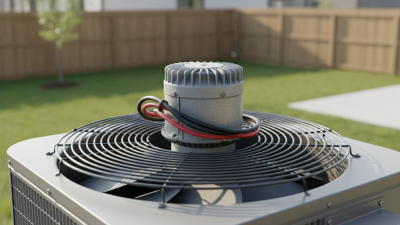
AC condenser motors play a crucial role in the cooling process of air conditioning systems. These motors are responsible for driving the fan that disperses heat from the condenser coils. Without a functioning condenser motor, your AC system cannot efficiently release heat, leading to reduced performance and possible system failures. A reliable motor ensures optimal airflow, enhancing overall cooling efficiency.
Understanding the function of condenser motors helps in making informed choices. When selecting a motor, consider its horsepower, voltage, and efficiency ratings. Opt for a motor designed for your specific unit size and local climate conditions. Choosing the wrong motor can increase energy costs and decrease the lifespan of your system. It's important to reflect on your options carefully to avoid potential pitfalls in performance and reliability.
Maintenance is another key aspect. Regularly checking the motor for wear and tear can prevent sudden failures. Look for unusual sounds or vibrations that may signal issues. Small problems can escalate quickly if not addressed. By being proactive, you not only prolong the life of the motor but also save yourself from costly repairs down the line. Taking these factors into account will help ensure you choose the right AC condenser motor for your home.
Identifying the Key Specifications for AC Condenser Motors
When selecting the right AC condenser motor, understanding key specifications is crucial. Motors vary widely in efficiency, power, and design. According to industry reports,
energy-efficient models can save up to 30% on electricity costs.
This efficiency is often labeled as SEER (Seasonal Energy Efficiency Ratio). A higher SEER rating often signifies better performance and lower operational costs.
Another critical specification is horsepower (HP). Motors typically range from 1/4 HP to 3/4 HP for residential applications.
It’s essential to match the motor's horsepower to the specific demands of your system. Over-sizing can lead to increased energy consumption. Conversely, under-sizing may result in inadequate cooling.
A study conducted by the Department of Energy highlighted that improper motor sizing can reduce system lifespan by up to 25%.
Consider also the motor's durability. Features like corrosion-resistant materials can enhance longevity. However, some low-cost options
may skimp on these vital features. This could lead to frequent replacements, increasing long-term costs.
Balancing initial investment with expected lifespan is an aspect worth pondering in your decision-making process. Be sure to evaluate all specs carefully, as this decision impacts both
comfort and finances for years to come.
Evaluating Different Types of AC Condenser Motors Available on the Market
Choosing the right AC condenser motor can be overwhelming. There are many types available, each serving different needs. The most common types include shaded pole, permanent split capacitor (PSC), and electronically commutated motors (ECMs).
Shaded pole motors are often less efficient and used in smaller units. PSC motors are more reliable and suitable for mid-range applications. ECMs offer the highest efficiency, but their cost can be a factor.
In evaluating motors, consider efficiency ratings and compatibility with your system. Look for motors with Energy Star certifications. This ensures you are choosing a reliable option.
Pay attention to noise levels, especially in residential areas. Some motors operate quietly, while others may produce noticeable sound. Installation practices can affect performance. Improper installation may lead to noise or energy loss.
It's important to think about your long-term needs. An efficient motor may cost more upfront, but savings on energy bills can outweigh the initial expense. Reflect on the size of the space you need to cool. A motor that is too small will struggle, while one that is too large can waste energy. Take your time before making a decision.
Assessing Energy Efficiency Ratings and Their Impact on Performance
When selecting an AC condenser motor, energy efficiency ratings play a crucial role. These ratings can significantly impact your energy costs over time. According to the U.S. Department of Energy, an energy-efficient motor can save up to 30% on electricity usage compared to standard models. This is not just about initial expense. Long-term savings can add up, reducing overall operational costs.
Understanding these ratings requires some attention. The efficiency is often measured in terms of horsepower and operational hours. For instance, a motor with a higher efficiency rating (like those over 90%) may cost more upfront, but could pay for itself within a few years. It’s essential to calculate your expected energy savings based on your local rates and usage patterns.
However, it can be misleading to focus solely on energy ratings. While they indicate efficiency, factors like installation quality and motor compatibility also influence performance. Poorly installed motors can negate energy savings, leading to frustrations. Additionally, industry reports suggest many users do not adequately maintain their motors, causing reductions in efficiency over time. Therefore, consider not just the specs, but also the entire system’s setup and ongoing care for optimal performance.
Factors to Consider for Proper Sizing and Installation of AC Motors
When selecting an AC condenser motor, proper sizing and installation are crucial. Industry reports indicate that incorrect sizing can lead to efficiency losses of up to 30%. Factors such as desired airflow and system capacity must be carefully considered. For residential units, a motor's horsepower rating is essential. A system intended for larger spaces will require a stronger motor to meet airflow demands efficiently.
Installation quality also impacts performance. Research shows that improperly installed motors can fail sooner, leading to increased maintenance costs. Maintaining proper alignment during installation is vital. Also, check for compatibility with existing equipment before making a purchase. Many technicians overlook these details, which can result in suboptimal performance. Regular inspections of the motor's operation and surrounding environment are recommended to enhance lifespan.
Balancing power consumption and airflow ensures energy efficiency. The U.S. Department of Energy emphasizes the importance of these factors. Choosing a motor that is too powerful wastes energy, while one that is too weak fails to cool effectively. Therefore, match your AC unit's requirements with a motor that meets industry standards for optimal results.
How to Choose the Right AC Condenser Motor for Your Needs?
| Factor |
Details |
Importance |
| Power Rating |
Select a motor with appropriate horsepower (HP) rating based on AC unit size. |
High |
| Voltage |
Ensure the motor matches the voltage specified by the air conditioning system. |
High |
| Bearing Type |
Consider ball bearings for longer lifespan and performance efficiency. |
Medium |
| Mounting Type |
Determine if the motor needs to be mounted horizontally or vertically. |
Medium |
| Speed |
Select between single-speed or multi-speed options depending on your system's requirements. |
High |
| Efficiency Rating |
Look for motors with high efficiency ratings to save energy costs. |
High |



 Email
Email Whatsapp
 WeChat